


Исполнители
Клипы
.mp4/2.jpg "Serebro О, мама (HD)")
.mp4/2.jpg "Serebro Пятница (HD)")
.mp4/2.jpg "Serebro Chico Loco (HD)")
.mov/2.jpg "Serebro Новый год (HD)")
.mp4/2.jpg "Serebro Мальчик (HD-Rip)")
 (HD).mp4/2.jpg "Serebro Пройдёт (Mood Video) (HD)")
.mp4/2.jpg "Serebro В космосе (HD)")
.mp4/2.jpg "Serebro Между нами любовь (HD)")
.mp4/2.jpg "Serebro Сломана (HD)")
 (HD).mp4/2.jpg "Serebro My money (feat Molly) (HD)")
 (HD).mp4/2.jpg "Serebro Я тебя не отдам (Emo Version) (HD)")
.mp4/2.jpg "Serebro Mi Mi Mi (HD)")
.mp4/2.jpg "Serebro Мальчик (HD)")
.mp4/2.jpg "Serebro Не время (HD)")
.mp4/2.jpg "Serebro Мама Люба (HD)")
.mp4/2.jpg "Serebro Давай держаться за руки (HD)")
.mp4/2.jpg "Serebro Скажи, не молчи (HD)")
.mp4/2.jpg "Serebro Опиум (HD)")
 (HD).mp4/2.jpg "Serebro Song number one (русская версия) (HD)")
 (HD).mp4/2.jpg "Serebro Chocolate (Matvey Emerson Fitness Remix) (HD)")
.mp4/2.jpg "Serebro Chocolate (HD)")
.mp4/2.jpg "Serebro Отпусти меня (HD)")
.mov/2.jpg "Serebro Дыши (HD-Rip)")
.mp4/2.jpg "Serebro Kiss (HD)")
 (HD).mp4/2.jpg "Serebro Перепутала (RE Music) (HD)")
.mp4/2.jpg "Serebro Перепутала (HD)")
.mp4/2.jpg "Serebro Я тебя не отдам (HD)")
 (HD).mp4/2.jpg "Serebro Угар (feat DJ M.E.G.) (HD)")
.mov/2.jpg "Serebro Сладко (HD)")
.mov/2.jpg "Serebro Мало тебя (HD-Rip)")
.mp4/2.jpg "Serebro Gun (HD)")
 (HD).ts/2.jpg "Serebro Song number one (Eurovision, Live 2007) (HD)")


.vob/2.jpg "Serebro Song number one (русская версия)")



Вернуться назад
Serebro
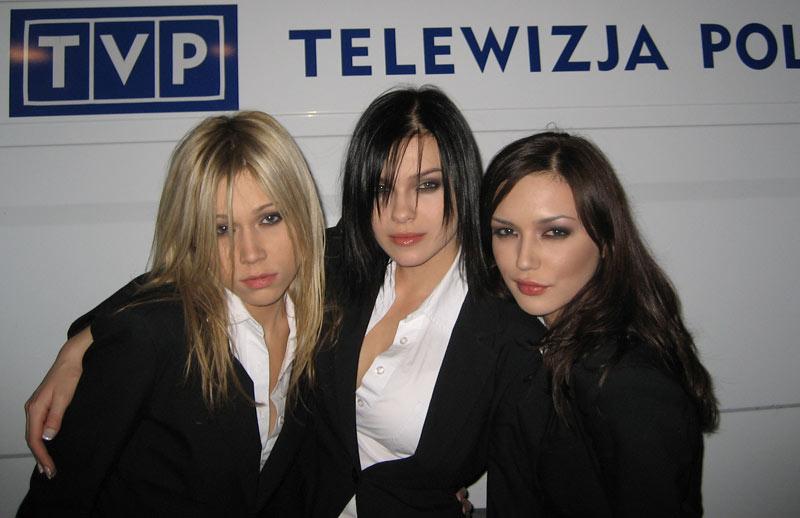
Serebro (Russian: Серебро, Silver) are a Russian trio, who finished third in the Eurovision Song Contest 2007 in Helsinki with the song "Song #1". The band was formed in 2006 by Maxim Fadeev, a prominent Russian music producer, and consists of Elena Temnikova, Olga Seryabkina and Anastasia Karpova, who replaced the former member Marina Lizorkina. Serebro is currently one of the most popular Russian bands; they released their debut album Opiumroz on 25 April 2009.
Members before Serebro
Members before Serebro
Elena Temnikova (born 18 April 1985 in Kurgan, Russia) came to media prominence as a contestant on Channel One talents show Star Factory in 2003. She was spotted by Maxim Fadeev, the main producer of Star Factory, and signed with a contract with Fadeev's recording company Monolit Records. Although Temnikova released two disco singles, "Begi" and "Taina", she did not continue her solo career, but joined Serebro.
Olga Seryabkina (born 12 April 1985 in Moscow, Russia) began to study ballet at the age of seven. The same year she got the rank of the candidate to the master of sports; she later took part in many international dancing competitions. Seryabkina graduated at the Art School, the Department for Estrada and Pop Singing, and in 2006 got the higher education diploma on specialization "Translation and Entrepreneurship". She was brought at the audition for Serebro by her friend Temnikova.
Anastasia Karpova (born 2 November 1984 in Balakovo, Russia) was very interested in music since her early age, but dedicated herself to ballet. She was also attending singing classes and decided to pursue her singing career.
Marina Lizorkina (born 9 June 1983 in Moscow, Russia) entered the Contemporary Art University in Moscow at the age of sixteen. She used to sing in a choir, before she became the lead singer of the group "Formula". In 2004, they released a few singles for the series Obrechonnaya Stat Zvezdoy. Lizorkina was the last to join Serebro, after she saw an Internet announcement.
History
Olga Seryabkina (born 12 April 1985 in Moscow, Russia) began to study ballet at the age of seven. The same year she got the rank of the candidate to the master of sports; she later took part in many international dancing competitions. Seryabkina graduated at the Art School, the Department for Estrada and Pop Singing, and in 2006 got the higher education diploma on specialization "Translation and Entrepreneurship". She was brought at the audition for Serebro by her friend Temnikova.
Anastasia Karpova (born 2 November 1984 in Balakovo, Russia) was very interested in music since her early age, but dedicated herself to ballet. She was also attending singing classes and decided to pursue her singing career.
Marina Lizorkina (born 9 June 1983 in Moscow, Russia) entered the Contemporary Art University in Moscow at the age of sixteen. She used to sing in a choir, before she became the lead singer of the group "Formula". In 2004, they released a few singles for the series Obrechonnaya Stat Zvezdoy. Lizorkina was the last to join Serebro, after she saw an Internet announcement.
Eurovision Song Contest 2007
In late March 2007, the jury commission of Russian national TV channel — Channel One were choosing Russia's representatives for the Eurovision Song Contest 2007. To everyone's surprise, the commission choose a fully unknown band named Serebro, which managed to overcome some famous native artists. In the Eurovision Song Contest 2006, Dima Bilan with his song "Never Let You Go" reached the second place which automatically allowed Serebro to perform in the 2007 final.
On the 12th of May, Serebro performed as number 15 in the final. They got 12 points from Armenia, Belarus, and Estonia and 10 points from Ukraine & Israel. The winner, Serbia, gave them 7 points. Serebro received third place at the Eurovision Song Contest 2007, with a total of 207 points. Serebro later said: "We are happy because of our third place. But, the most important thing is that we weren't there because of ourselves, it was for our fans, Russia and Russian people". The performance in Helsinki became their first official release and first concert for an audience.
2007—present: Opiumroz
After the success at Eurovision Song Contest 2007 in Helsinki, Serebro rapidly became one of the most popular bands in Russia. Since Summer 2007, the group has visited various concerts and events in Russia, Kazakhstan, Turkey, Poland, Uzbekistan, and Belarus. All band singles, without their real titles, are named Song#1, #2, #3, etc. As the group and their management have stated, so it will be easier to recall their songs.
Soon after the Eurovision contest, Serebro released "Song #1" as a single CD, which contained 13 different versions of "Song #1" marked by colours, as well as an extended version of the video. The girls then released a Russian version of "Song #1", called "Песня #1". It was Serebro's first Russian single. This song has two versions, original and censored. In July 2007, the group released their second song, "Дыши", which is also titled "Song #2". It became as popular as "Song#1" and climbed up to the top of the chart. Later in October, a video for "Дыши" was released.
At the RMA awards in early October 2007, Serebro performed a new song titled "What's Your Problem?", which is still unconfirmed as an official single and the song number of it is still unknown. Serebro was nominated in four categories at the MTV RMA 2007 awards: Best Pop-project, Best Debut, Best Song and Best Video. The voting results on the Internet allowed them to win the award for Best Debut. In December 2007, Serebro won another award at the Golden Gramophone Awards, a big music award ceremony organized by the biggest radio broadcaster in Russia, CIS. Serebro also won a World Music Award in 2007 for the best selling Russian artist. Unlike previous eastern European winners of a World Music Award (e.g. Ruslana from Ukraine in 2004 and Dima Bilan for Russia in 2006), Serebro did not perform at the event.
In late February, Serebro performed "Журавли" on Звэзда, a popular television programme in Russia, featuring artists singing patriotic songs. Originally written as a poem by Rasul Gamzatov "Журавли" is one of the most famous Russian songs coming out of World War II. On May 13, 2008 Serebro announced on their official website that they will be releasing their third official single, called "Опиум". The site says that the song will premiere on a Russian morning radio show BrigadaU on Europa Plus radio and that until March 17 Europa Plus will hold exclusive rights to play the song. The girls also announced they will release the English version of "Опиум". In English the song is called "Why".
In 2008 the group continued their work on their first album, Opiumroz , which had a projected release date of October 17. Unfortunately, there was a delay in the release of their debut album as there were some problems in the track list In November, the girls released the new song, "Скажи, не Mолчи" ("Say, Don't be silent"). In November 2008, Serebro was awarded by MTV RMA Awards for the Best Group.
After a release delay of their debut album, Opiumroz, it was finally released on 25 April 2009, and was presented at the band's concert in Poklonnaya Hill. Serebro was supported by other musicians, including by Russian entrant at the Eurovision Song Contest 2004 Yulia Savicheva; Opiumroz was prepared for two years.
On 18 June 2009 it was announced that Marina Lizorkina had left the band, due to both financial and personal reasons. Lizorkina was replaced by Anastasia Karpova. On 24 June 2009 Serebro announced they had finished work on their new music video for their fifth single "Like Mary Warner" which will be released in English and Russian ("Сладко" ; English: Sweet). This single is not featured on the band's debut album and will be the first song to feature the work of new Serebro member Anastasia Karpova. Serebro announced on 24 July 2009 they would take part in New Wave Festival in Yurmala, Latvia, with their song "Скажи, не молчи" and a cover of "Get the Party Started" by Pink.
On 29 March 2010 it was announced on Serebro's official website that the group will begin filming for a new music video starting on 4 April 2010. The group has also invited women between the ages of 18 and 30 with a "non-standard appearence (piercings, dreadlocks, braids, tattoos, vivid hair color, etc)" to send in applications to feature in their new video and are invited to do so until April 3, 2010. It is currently unknown what the song will be, be that a track from their debut album Opiumroz or a totally new song. This new single will be their latest after the June 2009 release of "Сладко".
Awards and nominations
In late March 2007, the jury commission of Russian national TV channel — Channel One were choosing Russia's representatives for the Eurovision Song Contest 2007. To everyone's surprise, the commission choose a fully unknown band named Serebro, which managed to overcome some famous native artists. In the Eurovision Song Contest 2006, Dima Bilan with his song "Never Let You Go" reached the second place which automatically allowed Serebro to perform in the 2007 final.
On the 12th of May, Serebro performed as number 15 in the final. They got 12 points from Armenia, Belarus, and Estonia and 10 points from Ukraine & Israel. The winner, Serbia, gave them 7 points. Serebro received third place at the Eurovision Song Contest 2007, with a total of 207 points. Serebro later said: "We are happy because of our third place. But, the most important thing is that we weren't there because of ourselves, it was for our fans, Russia and Russian people". The performance in Helsinki became their first official release and first concert for an audience.
2007—present: Opiumroz
After the success at Eurovision Song Contest 2007 in Helsinki, Serebro rapidly became one of the most popular bands in Russia. Since Summer 2007, the group has visited various concerts and events in Russia, Kazakhstan, Turkey, Poland, Uzbekistan, and Belarus. All band singles, without their real titles, are named Song#1, #2, #3, etc. As the group and their management have stated, so it will be easier to recall their songs.
Soon after the Eurovision contest, Serebro released "Song #1" as a single CD, which contained 13 different versions of "Song #1" marked by colours, as well as an extended version of the video. The girls then released a Russian version of "Song #1", called "Песня #1". It was Serebro's first Russian single. This song has two versions, original and censored. In July 2007, the group released their second song, "Дыши", which is also titled "Song #2". It became as popular as "Song#1" and climbed up to the top of the chart. Later in October, a video for "Дыши" was released.
At the RMA awards in early October 2007, Serebro performed a new song titled "What's Your Problem?", which is still unconfirmed as an official single and the song number of it is still unknown. Serebro was nominated in four categories at the MTV RMA 2007 awards: Best Pop-project, Best Debut, Best Song and Best Video. The voting results on the Internet allowed them to win the award for Best Debut. In December 2007, Serebro won another award at the Golden Gramophone Awards, a big music award ceremony organized by the biggest radio broadcaster in Russia, CIS. Serebro also won a World Music Award in 2007 for the best selling Russian artist. Unlike previous eastern European winners of a World Music Award (e.g. Ruslana from Ukraine in 2004 and Dima Bilan for Russia in 2006), Serebro did not perform at the event.
In late February, Serebro performed "Журавли" on Звэзда, a popular television programme in Russia, featuring artists singing patriotic songs. Originally written as a poem by Rasul Gamzatov "Журавли" is one of the most famous Russian songs coming out of World War II. On May 13, 2008 Serebro announced on their official website that they will be releasing their third official single, called "Опиум". The site says that the song will premiere on a Russian morning radio show BrigadaU on Europa Plus radio and that until March 17 Europa Plus will hold exclusive rights to play the song. The girls also announced they will release the English version of "Опиум". In English the song is called "Why".
In 2008 the group continued their work on their first album, Opiumroz , which had a projected release date of October 17. Unfortunately, there was a delay in the release of their debut album as there were some problems in the track list In November, the girls released the new song, "Скажи, не Mолчи" ("Say, Don't be silent"). In November 2008, Serebro was awarded by MTV RMA Awards for the Best Group.
After a release delay of their debut album, Opiumroz, it was finally released on 25 April 2009, and was presented at the band's concert in Poklonnaya Hill. Serebro was supported by other musicians, including by Russian entrant at the Eurovision Song Contest 2004 Yulia Savicheva; Opiumroz was prepared for two years.
On 18 June 2009 it was announced that Marina Lizorkina had left the band, due to both financial and personal reasons. Lizorkina was replaced by Anastasia Karpova. On 24 June 2009 Serebro announced they had finished work on their new music video for their fifth single "Like Mary Warner" which will be released in English and Russian ("Сладко" ; English: Sweet). This single is not featured on the band's debut album and will be the first song to feature the work of new Serebro member Anastasia Karpova. Serebro announced on 24 July 2009 they would take part in New Wave Festival in Yurmala, Latvia, with their song "Скажи, не молчи" and a cover of "Get the Party Started" by Pink.
On 29 March 2010 it was announced on Serebro's official website that the group will begin filming for a new music video starting on 4 April 2010. The group has also invited women between the ages of 18 and 30 with a "non-standard appearence (piercings, dreadlocks, braids, tattoos, vivid hair color, etc)" to send in applications to feature in their new video and are invited to do so until April 3, 2010. It is currently unknown what the song will be, be that a track from their debut album Opiumroz or a totally new song. This new single will be their latest after the June 2009 release of "Сладко".
- 2007: MTV RMA Awards for the Best Debut (WON)
- 2007: MTV RMA Awards for the Best Pop Project (Nominated)
- 2007: MTV RMA Awards for the Best Song (Nominated)
- 2007: Golden Grammophone Awards (WON)
- 2007: World Music Award for the Best-selling Russian Artist (WON)
- 2007: Muz-TV Awards for the New Act (Nominated)
- 2008: MTV RMA Awards for the Best Group (WON)
- 2008: MTV RMA Awards for the Best Video (Nominated)
- 2009: Muz-TV Awards for the Best Video (Nominated)
- 2009: Muz-TV Awards for the Best Pop-Group (Nominated)
- 2009: [Thee God of Ether] for the Radio Hit Group (WON)